
How much a data breach settlement pays per person
By Sunny, editor of PassiveYolk. Published November 12, 2026. Facts checked November 12, 2026.
Without receipts, what you can claim is the flat cash payment. The bigger “up to” amount on a claim site is usually a cap for losses you can prove. We listed 34 open data breach settlements on November 12, 2026. In 27 of them you could get cash with no proof, either a set amount or an estimate of $10 to $100. The median (the middle amount) was $50. Six of the other 7 offered a share of the fund instead. Those shares weren’t set yet, and we don’t know what they’ll come to. The seventh paid only for lost time and for losses you can prove.
I’ve gotten a data breach letter myself and filed a claim.
On 30 of the 34 there was a cap like that. It covered losses you can show with records such as bank statements or receipts, and a few also counted time spent. Those caps went from $500 to $8,500, with a median of $4,330. You get that much only if you lost that much and can show it. Our list shows both numbers for each open breach settlement, as its claim site states them.
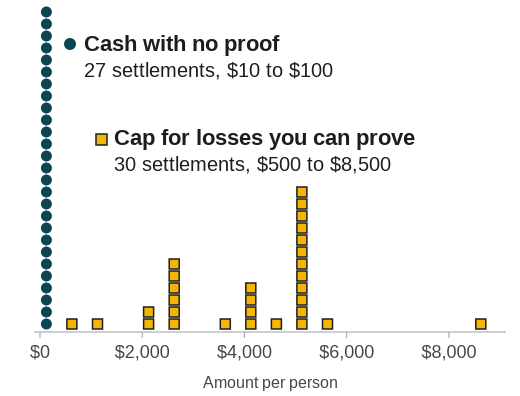
What the choices look like
On many breach settlements you pick one kind of payment. ECSI’s settlement offers either documented losses up to $5,000 or a cash payment of about $100, and its claims close December 21, 2026. At Inotiv’s settlement, you can claim documented losses plus up to $80 for time spent dealing with the breach (four hours at $20 an hour). Or you can skip those and take a one-time $45 with no proof. Claims there close December 2, 2026.
Monitoring often comes on top of the cash. Of the 34 listings, 29 mentioned credit, identity or medical monitoring. Columbia University’s settlement, for one, offers two years of credit monitoring along with either the cash or the loss payment (claims close January 21, 2027).
Why the cash amount can change
On 16 of the 34 listings, the cash was an estimate or a share, so the amount you get can go up or down. ECSI’s site says its cash payment can be reduced or increased depending on the total number of approved claims. Columbia’s cash payment is whatever is left in the fund after fees, costs, monitoring and loss claims are paid.
Most people who get a notice don’t file a claim. An FTC staff report from September 2019 studied 149 class actions, and in the ones that needed a claim, a median of 9 percent of the people sent a notice filed one. That report looked at class actions in general, not data breaches in particular, so take 9 percent as a rough guide here.
Payment also waits for the court. ECSI’s site says payments are made if the court approves the settlement, after any appeals are resolved, and its final approval hearing is set for January 11, 2027, three weeks after the claim deadline.
What “no proof needed” means
You send no receipts for the flat payment, but you still sign. ECSI’s claim form ends with a sworn statement, under penalty of perjury, that everything on it is true. File only if the notice’s description fits you.
Most need the ID from the notice
Of the 34, 31 asked for the ID printed on the settlement notice, and 2 more let you file with or without it. If the notice is gone, the contact page on the official claim site is the place to ask for the ID. Our claim ID guide lists what claim forms call it, from Notice ID to Access Code.
Protect your accounts, whether you file or not
The FTC’s advice after a breach depends on what was exposed. IdentityTheft.gov/databreach sorts its steps by type, and the FTC’s printed brochure, Data Breaches: What to Know, What to Do (September 2016), starts with these.
- If your Social Security number was exposed, take the free credit monitoring if the company offers it, get your free credit reports from annualcreditreport.com, and consider a credit freeze. The FTC says a freeze is free to place or lift, doesn’t affect your credit score, and has to be placed with each of the three credit bureaus.
- If a password was exposed, change it on that site and anywhere else you used it.
- Ask your bank or card company to close an exposed account or cancel an exposed card and give you a new one.
Open now
- Fujifilm Diosynth data breach settlement: Last day: Wed, Nov 25 (check the closing time)
- Finastra Technology data breach settlement: File by Fri, Nov 27
- Hire Velocity data breach settlement: File by Mon, Nov 30
Sources
- PassiveYolk open settlements list, the 34 data breach settlements counted November 12, 2026
- ECSI data breach settlement, official site (claims close December 21, 2026)
- ECSI data breach settlement, paper claim form
- Inotiv data breach settlement, claim page (claims close December 2, 2026)
- Columbia University data breach settlement, official site (claims close January 21, 2027)
- FTC staff report: Consumers and Class Actions, A Retrospective and Analysis of Settlement Campaigns (September 2019)
- IdentityTheft.gov (FTC): data breach steps
- FTC and IdentityTheft.gov: Data Breaches, What to Know, What to Do (September 2016)
- FTC consumer alert: Get a credit freeze to stop identity thieves (September 10, 2025)
General information, not legal advice. If a settlement’s official site says something different, go by what it says. Nothing in this guide is a paid link, and our page on how we make money lists what does pay for the site.